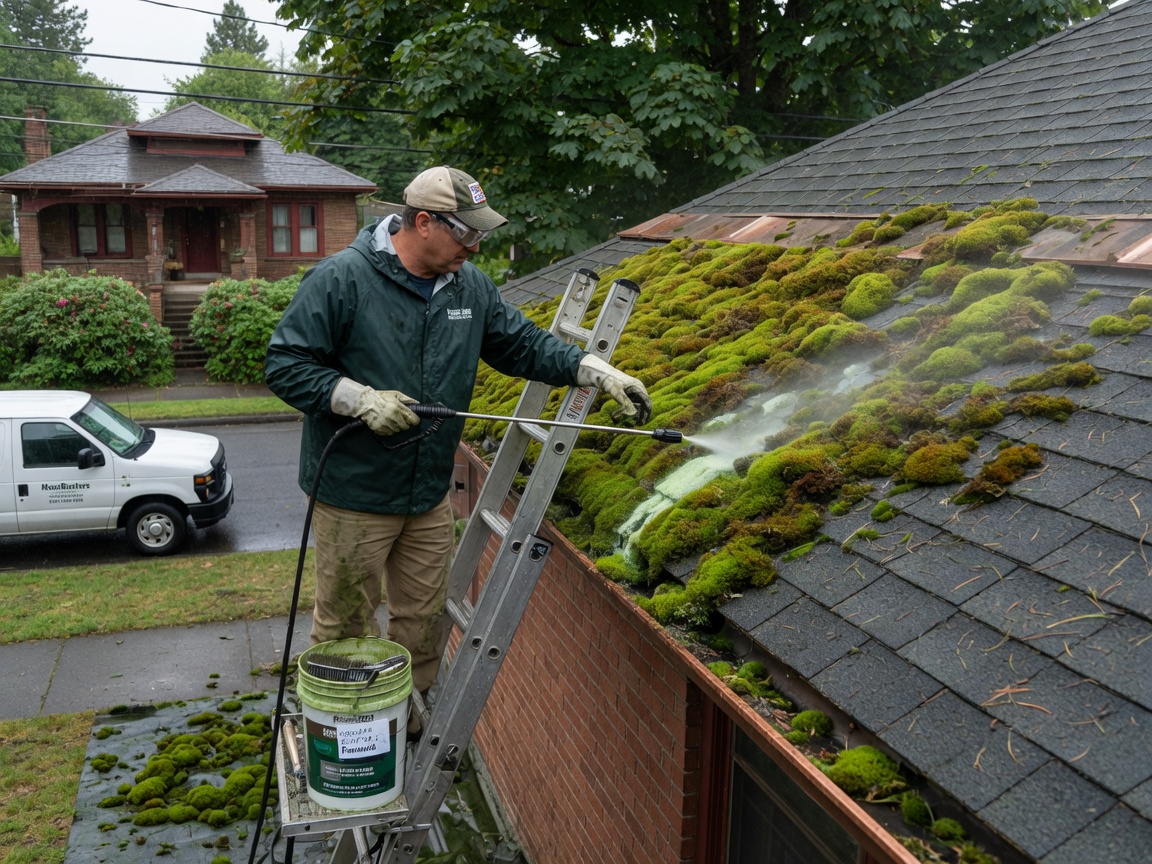
Spokane homes built before 1980 in neighborhoods like the South Hill and Browne's Addition often have asphalt shingles that hold moisture when moss takes hold. North-facing slopes and areas shaded by mature trees stay damp through winter rains, allowing spores to spread across valleys and ridges, and untrimmed branches overhead sometimes call for tree limb removal at the same time. Treating early stops the moss from lifting granules and exposing felt to UV and freeze-thaw cycles common in Spokane County.
We apply zinc-based or copper-sulfate solutions formulated for Pacific Northwest roofs, letting the product work for several days before gentle brushing removes the dead mat. This method avoids high-pressure washing that can drive water under flashing on older homes, especially in Emerson-Garfield. Crews pay special attention to valleys, step flashing, and ridge vents where debris collects and re-seeding occurs fastest, and a roof rejuvenation treatment can follow once the moss is cleared.
After treatment we install zinc or copper strips along the ridge on homes that show repeated growth. These strips release ions with each rain, slowing regrowth for three to five seasons in Spokane's climate, a routine we also recommend for properties in East Central. Homeowners receive a written schedule noting when to re-inspect, especially after heavy leaf drop from surrounding maples and pines, and clogged runoff points to overdue gutter cleaning.
All work occurs during business hours of Mon-Fri 8am-6pm and Sat 9am-2pm so crews can finish before evening dew sets in. We leave the site clean of clippings and dispose of material off-site rather than blowing it into yards.
Technician insight
In Spokane, the thing that catches most people out with moss removal treatment is how quickly growth returns on north slopes once the trees leaf out; older South Hill homes with limited attic ventilation stay damp longer, so the treatment needs the zinc strips or homeowners are back on the phone the next spring.
South Hill Split-Level Roof
Heavy moss covered the back slope shaded by fir trees. Inspection showed lifted shingles and soft felt along the valley. Treatment killed the mat, brushing cleared it, and zinc strips were added along the ridge. The roof dried out and no new growth appeared after the following winter rains.
Moss Removal Treatment Services We Offer
✓Asphalt Shingle Moss Removal
Removes established moss mats from three-tab and architectural shingles without damaging the granule surface on Spokane homes.
✓Cedar Shake Moss Treatment
Applies penetrating treatment to cedar roofs common on older Spokane properties while preserving the wood's natural expansion joints.
✓Zinc Strip Installation
Adds continuous zinc or copper strips along ridges to release ions that inhibit new moss growth for multiple seasons.
✓Valley and Flashing Clearing
Targets heavy moss buildup in valleys and around step flashing where water pools on Spokane roofs during winter rains.
✓Preventive Inhibitor Spray
Applies maintenance spray on clean roofs in shaded Spokane neighborhoods to reduce spore germination before visible mats form.
Moss Removal Treatment Cost in Spokane, WA
| Service | Typical Range | What Affects It |
|---|---|---|
| Typical single-story home treatment | $350–$650 | Includes application and removal; price rises with two-story access or multiple valleys. |
| Zinc strip addition | $150–$300 | Per ridge line; material and labor included. |
| Preventive spray only | $200–$400 | For roofs already clear of heavy growth. |
| Cedar shake treatment | $450–$850 | Higher due to careful application on wood surfaces. |
Ranges are typical for Spokane, WA and confirmed with an exact written quote before any work starts.
How it works
- 1
Roof Walk And Moisture Check
Technician inspects every slope, valley, and penetration for active moss and signs of trapped water on the specific Spokane property.
- 2
Solution Application
Low-pressure spray coats the growth with treatment formulated for local rainfall patterns and lets it dwell without runoff into gutters.
- 3
Dead Moss Removal
Soft brushing lifts the dead layer into collection tarps, keeping debris off landscaping and driveways below.
- 4
Strip Placement And Final Walk
Zinc strips are fastened where needed and the entire roof is checked for any missed spots before crews leave the site.
Pricing
Most Spokane homes need treatment every three to four years; exact cost depends on roof size, slope access, and whether zinc strips are added.